

Here’s the thing about scholarships: it's not always about having a perfect 4.0 GPA. The real secret is playing to your strengths. It's about finding the awards where your unique story, skills, and ambitions are exactly what the committee is looking for, and then crafting an application that makes them sit up and take notice.
Your Scholarship Journey Starts Now
The whole idea of "winning a scholarship" can feel intimidating. We often picture a mountain of applications and cutthroat competition for a tiny prize, reserved for a handful of academic superstars. But that’s not the whole picture.
Landing a scholarship is a completely achievable goal for students of all kinds. The trick is to stop thinking of it as a lottery and start treating it like a project. A manageable project with clear steps.
This guide will walk you through four key phases: discovering opportunities, preparing your materials, submitting a killer application, and following up. We'll break it down, showing you how to pinpoint awards that fit your specific skills, your real-world experiences, and even your hobbies—many of which have little to do with your report card.
Understanding the Scholarship Landscape
Scholarships aren't just a monolithic pile of money. Each one is created by a different group for a very specific reason. Some want to boost the next generation of engineers, while others are designed to support students from a certain hometown or those who have overcome a specific challenge. Your job is to find the scholarships where your personal story clicks with their mission.
In the U.S., scholarships are a huge piece of the college funding puzzle. A staggering 58% of families rely on them to help pay for tuition. With over 1.7 million different scholarships awarded every year, adding up to around $46 billion, the opportunities are definitely out there. You can explore more about these scholarship statistics to see just how big the landscape is.
This image gives you a great visual breakdown of the different types of scholarships you'll encounter.
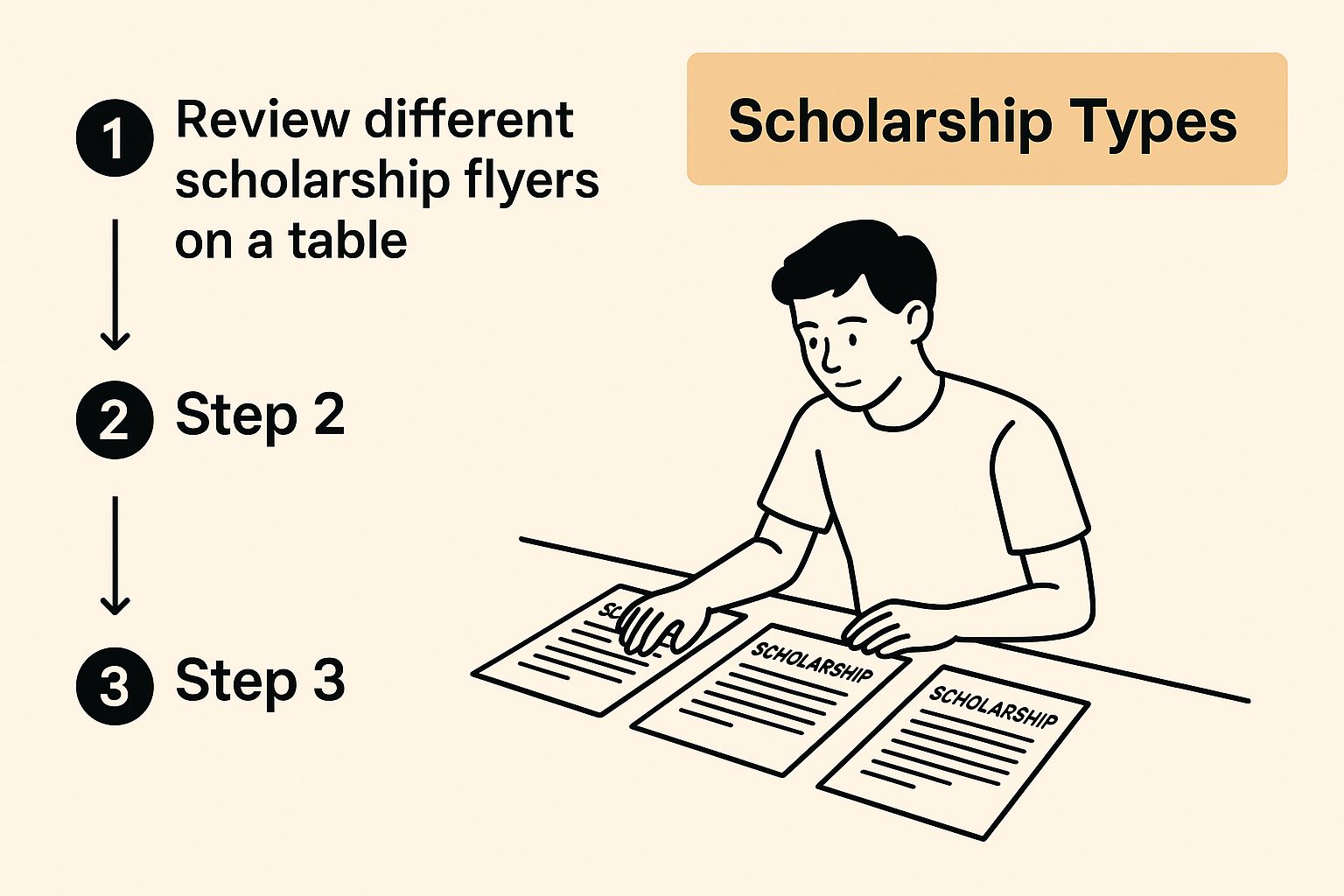
As you can see, it's not all about academic merit. Your search can—and should—include awards for athletics, community service, creative talents, and so much more.
Building Your Strategic Roadmap
My best advice? Ditch the scattergun approach. Applying to every scholarship under the sun is a surefire way to burn out. Instead, get strategic. Think of yourself as a brand and your application as the marketing pitch. A great pitch is tailored to its audience. Your goal is to create a compelling package that speaks directly to the heart of what each scholarship provider values.
The students who win scholarships aren't always the ones with the highest grades. They're the ones who can clearly connect the dots between what they've done, where they're going, and why that scholarship is the perfect bridge to get them there.
That's the roadmap this guide provides. It’s designed to help you shift from feeling overwhelmed to feeling empowered and prepared. You’ll learn not just where to look for scholarships, but how to look, so you can pour your energy into the applications you have a real shot at winning.
To get started, it helps to see the entire process laid out. Here's a high-level view of the journey ahead.
The Scholarship Application Lifecycle at a Glance
This table summarizes the core stages you'll work through, from the initial hunt for opportunities to what happens after you hit "submit."
| Stage | Key Objective | Essential Action |
|---|---|---|
| Phase 1: Discovery | Identify relevant scholarships | Research databases, connect with your school's financial aid office, and build a master list of potential awards. |
| Phase 2: Preparation | Gather your core application materials | Polish your CV/resume, draft a compelling personal statement, and request strong letters of recommendation. |
| Phase 3: Application | Tailor and submit each application | Customize your essays for each specific scholarship, double-check all requirements, and submit well before the deadline. |
| Phase 4: Follow-Up | Manage post-submission communications | Send thank-you notes to your recommenders, monitor your email for updates, and prepare for potential interviews. |
Think of this as your game plan. By focusing on one stage at a time, the entire process becomes far less daunting and much more strategic.
Find Scholarships You Can Actually Win
The single biggest mistake I see students make is casting way too wide a net. They get stuck in a frustrating cycle, spending hours on huge search engines and firing off applications to dozens of national awards. This shotgun approach is exhausting, and frankly, it rarely works.
There’s a much smarter way to play the game. You want to build a targeted list of 15 to 20 high-probability scholarships. These are the awards where your unique background, skills, and even where you live give you a genuine edge. It’s all about finding your niche, not just blindly filling out forms.
Let's be realistic: winning a scholarship is tough. While about 7% of students land some type of scholarship, only a tiny 0.2% secure awards over $25,000. The secret isn't applying for more; it's applying for the right ones. To dig deeper into the numbers, check out these scholarship award statistics on ThinkImpact.com.
This mindset shift—from quantity to quality—is your first real step toward winning money for college.
Start Local Before Going National
Your biggest advantage is probably right in your own backyard. National scholarships are a feeding frenzy, attracting tens of thousands of applicants. Local awards, on the other hand, are only open to students from your city, county, or state. The competition shrinks instantly.
Think about the organizations that make your town what it is. Many have deep community roots and a genuine mission to support local kids.
Here’s where to look for these hidden gems:
- Community Foundations: Almost every county or major city has one. These foundations manage dozens of unique scholarship funds set up by local families and businesses specifically for students like you.
- Local Businesses and Credit Unions: Check the websites of the big employers in your area. Banks, credit unions, and even manufacturing plants often offer scholarships, sometimes just for being a local resident.
- Civic and Service Clubs: Groups like the Rotary Club, Kiwanis International, and Lions Clubs are pillars of local philanthropy. They've been giving out scholarships to graduating seniors for decades.
Sure, the prize money for these might be smaller, but winning several local awards can add up fast and take a serious bite out of your tuition bill.
Tap into Institutional Scholarships
One of the most overlooked goldmines is the financial aid office at the colleges you're actually applying to. Beyond federal aid, universities have their own stash of cash called institutional aid that they use to attract great students.
You’re often automatically considered for some merit money when you get accepted. But the best awards—the ones with bigger dollar signs—usually require a separate application.
Pro Tip: Don't just sit back and wait for an offer. Be proactive. Dive into the financial aid section of each college's website and look for a "scholarship directory" or "endowed scholarships" page. You'll find opportunities tied to your major, academic interests, or even your high school.
These scholarships are often funded by alumni who want to give back. For instance, a successful engineer might create a scholarship for female engineering students from her home state. Those specific criteria are your best friend because they narrow the applicant pool in your favor.
Uncover Niche Scholarships That Fit You
This is where your personal story becomes your superpower. Scholarship committees love to see a clear passion or a unique background. It's time to think beyond your GPA and transcripts and focus on what makes you you.
Niche scholarships are based on an incredible variety of factors.
Examples of Niche Categories
| Category | Potential Scholarship | Real-World Scenario |
|---|---|---|
| Heritage or Background | Awards for students of Irish, Italian, or Hispanic descent. | A student whose family is active in a local Polish-American cultural center finds a heritage-based award. |
| Hobbies and Talents | Scholarships for caddies, skateboarders, knitters, or even duck-callers. | An avid gamer who runs a small online tournament discovers a scholarship for students pursuing esports management. |
| Unique Circumstances | Aid for first-generation students, twins, or left-handed people. | A student who is the first in their family to attend college focuses their entire search on "first-generation" awards. |
| Career Aspirations | Funding for future librarians, welders, or urban planners. | A high schooler passionate about sustainable farming finds scholarships from organic agriculture associations. |
The more specific the scholarship, the smaller the pool of people you're competing against. Someone applying for the "Vegetarian Resource Group Scholarship" is up against a much smaller, more defined group than the thousands vying for a general corporate merit award.
Your goal is to build a list that’s a strategic mix: local opportunities, institutional aid from your top-choice schools, and niche awards that only you are perfect for. This approach positions you as the ideal candidate, not just another name in the pile.
Build a Standout Application Package

Alright, you've scouted the field and have a solid list of scholarships you're targeting. Now, the real work begins. It’s time to shift from finding opportunities to actually winning them.
A winning application isn't just a random assortment of documents. It’s a story. Your story. Every single piece—from your resume and essays to your letters of recommendation—needs to weave together to present a clear, compelling picture of who you are and why you're a fantastic investment for their money.
This is where you go beyond simply checking boxes. The goal is to make the scholarship committee feel like they know you and get them genuinely excited to back your future. You need to show your potential, not just talk about it.
Crafting a Purpose-Driven Scholarship Resume
First things first: your scholarship resume is not your job resume. Its entire purpose is different. Forget listing every part-time gig you’ve ever had. Here, you need to be strategic, highlighting experiences that echo the scholarship's core values.
Applying for an award that prizes community leadership? That role as treasurer for the robotics club is gold. Your summer job bagging groceries? Not so much.
Think of this document as your personal highlight reel. Every entry should put a skill or quality on display, whether that’s initiative, responsibility, or collaboration. And please, use action verbs and numbers whenever you can. Quantifying your achievements gives them real weight.
For instance, don't just say you volunteered at the food bank. Frame it with impact:
- The "Meh" Version: Volunteered at the community food bank.
- The "Wow" Version: Coordinated a team of 5 student volunteers to sort and package over 2,000 pounds of food donations for local families.
See the difference? That simple tweak transforms you from a passive participant into an active contributor—exactly what committees are looking for.
Securing Letters of Recommendation That Shine
A truly great letter of recommendation is more than just a confirmation that you’re a good student. It’s a powerful, third-party endorsement of your character, your drive, and your potential. The secret lies in choosing your recommenders wisely and then making it incredibly easy for them to write you a stellar review.
Whatever you do, don't just fire off an email to a teacher a week before the deadline. That’s a recipe for a generic letter.
Instead, approach them in person at least three to four weeks in advance. Come prepared with a simple "brag sheet" or portfolio that includes:
- Your scholarship resume: This gives them a quick snapshot of your accomplishments.
- The scholarship description: Highlight the specific criteria the committee cares about, like leadership or creativity.
- A draft of your essay: This shows them the narrative you’re building and helps them add to it.
- A reminder of your work in their class: Mention a specific project you nailed or a moment you showed real curiosity.
Always wrap up your request by asking, "Do you feel you know me well enough to write a strong letter of recommendation for me?" It’s a polite and professional way to give them an out. This simple question can save you from getting a lukewarm letter that does more harm than good.
This little bit of prep work makes their job a breeze and ensures their letter reinforces the exact message you want to send.
Transforming Activities into Impact Stories
Most applications have a section for extracurriculars, and most students waste it. They just list their activities and move on. This is your chance to leapfrog the competition.
Instead of just listing what you did, tell mini-stories of your impact. The key is to focus on the outcome of your involvement, not just the fact that you showed up.
Let's look at a few makeovers.
From Vague to Valuable: Describing Your Activities
| Vague Description (Before) | Impactful Description (After) | Qualities Highlighted |
|---|---|---|
| Member of the Debate Club | "As a senior member, I researched arguments for regional competitions and mentored junior members on case construction, contributing to our team's first-place finish at the state tournament." | Leadership, mentorship, dedication |
| Volunteered at Animal Shelter | "Dedicated 100+ hours to socializing timid animals to improve adoption prospects and helped create online pet profiles, which led to a 15% increase in adoptions over six months." | Commitment, initiative, results-oriented |
| Cashier at a Local Cafe | "Managed customer transactions in a fast-paced environment, trained two new employees on the POS system, and was part of a team that consistently earned a 95% customer satisfaction rating." | Responsibility, teamwork, reliability |
By injecting specific details and metrics, you’re providing hard evidence of your skills. You're no longer just a "member" of a club; you're a leader, a mentor, and a doer. This is how you show a committee your potential, and it’s how you build an application that’s impossible to ignore.
Write Scholarship Essays That Connect

If your resume and transcripts are the skeleton, your essay is the heart. This is your one real chance to speak directly to the scholarship committee, to move beyond grades and test scores and show them who you really are. It’s where you make a genuine, human connection.
A great scholarship essay isn't just well-written; it's authentic. It tells a story only you can tell, linking your personal experiences to your ambitions in a way that truly resonates with the scholarship provider’s mission. So, forget trying to sound like the "perfect" student. The real goal is to sound like yourself.
Many students get stuck on the prompts, which can feel huge and intimidating. But once you learn to decode what the committee is really asking, you can craft a narrative that's both personal and persuasive.
Let's break down how to do just that.
Decoding Common Essay Prompts
Most scholarship prompts circle back to a few core themes: your goals, your character, and your potential. The trick is to see past the surface-level question to understand the deeper quality they want to see. Your story then becomes the evidence.
Here’s a look at some of the most frequent prompts and what the committee is actually trying to figure out.
-
The Prompt: "Why do you deserve this scholarship?"
- What They're Really Asking: "Show us you're a good investment. How do your past actions and future plans align with our organization's values and mission?"
- How to Answer: Don't just list your financial needs. Connect your specific goals directly to their mission. For example, if you're applying for a scholarship from a community bank, talk about your plan to study economics to one day support local small businesses.
-
The Prompt: "Describe a time you overcame a challenge."
- What They're Really Asking: "Can you demonstrate resilience, problem-solving skills, and maturity? We want to see that you learn and grow from tough situations."
- How to Answer: Focus less on the drama of the challenge itself and more on what you did and, most importantly, what you learned. The outcome and your reflection are the key parts of this story.
-
The Prompt: "Who is your role model?"
- What They're Really Asking: "What qualities do you admire and want to embody? Show us what values guide you."
- How to Answer: Avoid generic choices like a parent or a famous celebrity unless you have a deeply personal and unique story. It’s often more powerful to choose a teacher, a mentor, or even a local community figure and explain how their specific actions inspired your own.
Understanding the real question is half the battle. The other half is finding the right story from your own life to answer it.
Find Your Unique Story Angle
Everyone has a story. The key is finding the one that best answers the prompt while showcasing your unique strengths. Remember, committees read hundreds, sometimes thousands, of these essays. The ones that cut through the noise are those that feel genuine and offer a fresh perspective.
To find your best angle, steer clear of the big, sweeping clichés. Winning the championship game or acing a tough final are common topics that don't really reveal much about your character.
Instead, zoom in on the small, specific moments that truly shaped you. Think about a time you had to mediate a conflict between friends, learn a new skill that felt impossible at first, or make a tough decision that went against the grain. These smaller, more personal anecdotes are often far more powerful.
Once you have a moment in mind, use the STAR method to give your story a clear, compelling structure.
- Situation: Briefly set the scene. Where were you? What was the context? (1-2 sentences)
- Task: What was the specific goal or challenge you were facing? (1 sentence)
- Action: This should be the bulk of your story. Describe the specific steps you took. Use strong "I" statements and active verbs. (3-4 sentences)
- Result: What happened? What did you learn or how did you grow from the experience? Be sure to connect this lesson back to your future goals or the scholarship's purpose. (2-3 sentences)
This framework keeps your essay focused and transforms a simple memory into a powerful story of your personal growth.
Write with Confidence and Personality
Your tone matters just as much as your content. Scholarship committees aren't looking to fund academic robots; they want to support interesting, passionate people who will make a difference. Let your personality come through in your writing.
This doesn't mean filling your essay with slang or trying to be funny. It simply means writing in a clear, confident voice that feels natural. A great way to check this is to read your sentences out loud. Do they sound like something you would actually say? If not, rewrite them until they do.
Finally, proofread like your funding depends on it—because it just might. Typos and grammatical errors can signal a lack of attention to detail. After you've edited it yourself, ask a trusted teacher, counselor, or mentor to read it over. A fresh pair of eyes will catch mistakes you’ve missed and help you figure out how to get a scholarship by ensuring your story connects as powerfully as possible.
Go Beyond the Basics with Advanced Scholarship Strategies
You've built a strong application and crafted a narrative that tells your story. Honestly, that puts you way ahead of the curve. But now it’s time to shift gears and think like a serious contender. The following strategies are what I've seen separate the "almosts" from the actual winners. They show a level of foresight and professionalism that scholarship committees absolutely notice.
This isn't about being a perfect student. It's about being a smart one. We're moving past just filling out forms and into running a coordinated campaign to present you as the undeniable best choice. This approach shows you’re strategic about your future—a quality every single scholarship provider is looking for.
These tactics don't require a 4.0 GPA or a laundry list of awards. They just take a bit of smart preparation and a willingness to go that extra mile.
Create a Scholarship "Master File"
If you're applying for 15-20 scholarships (and you should be), you’ll be doing a lot of writing. But you don't have to reinvent the wheel every single time. The secret is to work smarter, not harder. I always tell students to create a central document—a "Master File"—to house their core application materials.
This isn't a license to copy and paste blindly. Think of it as building a personal library of your best work, ready to be adapted for any prompt that comes your way.
Here’s what your Master File should contain:
- Your Core Personal Statement: A rock-solid, 500-word essay that nails your goals, motivations, and personal story.
- A "Story Bank": A simple list of bullet points detailing your key experiences, challenges you've overcome, and proudest accomplishments. These are your go-to anecdotes.
- Multiple Essay Versions: A few pre-written drafts that tackle common themes you'll see again and again, like leadership, community service, or a time you failed.
Now, when a new application asks you to describe a challenge, you won't be staring at a blinking cursor. You'll simply pull the relevant story from your file and spend your energy tailoring it to fit the scholarship's unique mission and word count. This system easily saves dozens of hours and keeps your core message consistent and polished across all applications.
Polish Your Professional Online Presence
Let’s be real: it’s 2024. It is almost a guarantee that someone on the scholarship committee will do a quick search for your name online. What are they going to find?
Taking control of your digital first impression is a simple but incredibly effective way to reinforce your application. You don't need a fancy personal website. A clean, professional LinkedIn profile is all it takes.
A sharp LinkedIn profile is the digital companion to your resume. It gives you the space to elaborate on your experiences, add a professional headshot, and even gather endorsements from teachers or mentors, adding a powerful layer of credibility.
Make sure your profile is complete and mirrors the achievements listed on your resume. Use a clear, friendly photo and write a headline that immediately communicates your focus, like "Aspiring Marine Biologist & Community Volunteer." It’s a small step that presents you as a serious, forward-thinking candidate.
Ace the Scholarship Interview
Getting an interview invitation is a huge deal—it means you're a finalist. This is your moment to bring your application to life and connect with the committee on a human level. Preparation is everything. Start by thinking through common questions and actually practicing your answers out loud.
Here are a few questions you should absolutely be ready for:
- "Tell me about yourself." This is your opener. Have a crisp, 90-second "elevator pitch" ready that connects your past experiences, current activities, and future aspirations.
- "Why did you apply for this scholarship?" This is where your research shines. Reference the organization's specific mission or values and clearly explain how they align with your own goals. Show them you didn't just mass-apply.
- "What are your biggest strengths and weaknesses?" Be honest but strategic. For your weakness, pick something genuine but frame it as an area of growth you're actively working to improve.
Scholarships truly change lives. Just look at the Benjamin A. Gilman International Scholarship Program. Since 2001, it has opened doors for thousands of students from all walks of life. Nearly 60% of Gilman scholars come from small towns, and about half are first-generation college students, proving the immense impact of targeted financial aid. You can learn more about the Gilman Program's statistics to see just how these awards create new pathways. Nailing the interview is your final step to securing one of these incredible opportunities.
Answering Your Top Scholarship Questions
Going through the scholarship process is bound to bring up some questions. It's totally normal to wonder if you're doing things right as you hunt for opportunities and work on your applications. Let's tackle some of the most common things students worry about so you can move forward with confidence.
Think of this as your go-to guide for those nagging "am I on the right track?" moments. We'll clear up the big questions about how many scholarships to apply for, what to do if your GPA isn't perfect, and when you should really get started.
So, How Many Scholarships Should I Actually Apply For?
This is a classic question, but there’s no single magic number. The real key is quality over quantity. I've seen students make the mistake of firing off 100 applications with the same generic essay, and it rarely works. A much better approach is to build a highly curated list of 15 to 25 scholarships where you’re a fantastic match for what they're looking for.
Focusing your energy this way means you can give each application the attention it deserves, especially the essays. When you customize your story for a specific scholarship provider, it shows you've done your homework and are genuinely interested. That effort dramatically increases your chances compared to a scattergun approach. Trust me, it's far better to send in ten truly outstanding applications than fifty forgettable ones.
Can I Get a Scholarship with a Low GPA?
Yes, you absolutely can. While plenty of scholarships are all about academic merit, thousands of others couldn't care less about your GPA. Your grades are just one piece of the puzzle, and many scholarship committees are much more interested in who you are as a person.
To find these awards, you just need to adjust your search filters. Look for scholarships that are based on things like:
- Financial Need: Many organizations want to help students who need it most, regardless of their grades.
- Community Service: Your volunteer work and dedication to a cause can be your most powerful asset.
- A Specific Talent: If you're an artist, a musician, a writer, or an athlete, there are tons of awards just for you.
- Your Unique Story: There are scholarships for first-generation students, people from specific backgrounds, or students who have overcome major challenges.
Many providers will place a lot more weight on your personal essay, your leadership potential, and your resilience than on your transcript. Your job is to find the awards that value your unique strengths.
Don't let a number on your report card hold you back. The right scholarship committee is looking for your passion and potential—things a GPA could never measure.
When Is the Best Time to Start Applying?
The best answer I can give you is: right now. Scholarship deadlines are all over the calendar, not just clustered in the spring. If you wait until the last minute, you're just signing yourself up for stress and will likely submit rushed, weak applications.
Here’s a great strategy: start your serious search the summer before your senior year of high school (or the year before you plan to attend college). That timeline gives you plenty of breathing room to research, get your documents in order—like transcripts and recommendation letters—and write essays that truly shine, all without the pressure of a deadline breathing down your neck. Starting early is one of the simplest competitive advantages you can give yourself.
At Izent Education, we're here to help you unlock your educational future. We offer expert guidance on finding and winning scholarships to study anywhere in the world. Explore our resources and start your journey today.
Article created using Outrank