

Before anyone reads a single word of your essay, its appearance has already made a first impression. It’s a subtle but powerful signal. A cleanly formatted document tells the scholarship committee you’re serious, professional, and you respect their time. On the flip side, messy or hard-to-read formatting can suggest a lack of attention to detail, which is a red flag for any selection committee.
Think of it as the professional handshake before you start your pitch. Getting the small details right shows you understand the expectations and are ready to meet them.
Don't Guess—Follow the Standard
When a scholarship application doesn't give you specific formatting rules, don't just wing it. There's a widely accepted academic standard that serves as a professional default. Sticking to these guidelines ensures your essay is easy to read and looks polished, allowing your story and arguments to take center stage.
Remember, with potentially thousands of applications to sort through, reviewers appreciate consistency. An estimated 85% of scholarship essays are expected to follow these standard guidelines to even be considered. You can learn more by exploring data on academic writing standards.
Here are the key elements to lock in:
- Font Choice: Stick with the classics. Times New Roman is the old standby, but Arial or Calibri are also perfectly acceptable, professional choices. The goal is readability, so steer clear of any decorative or script fonts that might be hard to scan quickly.
- Font Size: 12-point font is the universal standard for a reason. Go any smaller, and you risk straining the reader’s eyes. Any larger, and it can look a bit amateurish or like you're trying to stretch a short essay to meet a page count.
- Margins: Set your margins to 1 inch on all four sides—top, bottom, left, and right. This creates a clean frame of white space around your text, making the page feel less cluttered and more inviting to read.
A well-formatted document subtly communicates your professionalism and attention to detail. It's a small step that can make a big difference in how your application is perceived.
When specific instructions aren't provided, this checklist is your go-to for ensuring your essay is readable, professional, and polished.
Standard Scholarship Essay Formatting At a Glance
| Formatting Element | Standard Guideline | Why It Matters |
|---|---|---|
| Font Style | Times New Roman, Arial, or Calibri | Ensures maximum readability and a professional look. |
| Font Size | 12-point | The industry standard for academic and professional documents. |
| Spacing | Double-spaced (2.0) | Makes the text easier to read and provides room for comments. |
| Margins | 1-inch on all sides | Creates a clean, uncluttered layout and prevents text from being cut off. |
| Alignment | Left-aligned | The standard for most documents; justified text can create awkward spacing. |
| Indentation | Indent the first line of each paragraph by 0.5 inches. | Clearly separates paragraphs, improving the essay's structure and flow. |
| Header | Include your name and the essay title/prompt. | Helps identify your work, especially if pages are printed and separated. |
| Page Numbers | Place in the top-right or bottom-center. | Keeps your document organized and easy to navigate. |
Following these guidelines ensures that the first thing a reviewer notices is the quality of your ideas, not a distracting formatting choice.
Building Your Essay's Structure for Maximum Impact

Beyond just fonts and margins, the logical flow of your essay is what really pulls a reviewer through your story. A solid structure can be the difference between a good essay and a truly unforgettable one. Think of it as building a narrative framework that hooks them from the very first sentence and doesn't let go.
This isn’t just about making it look pretty; it has a real, measurable impact. A massive review of over 10,000 scholarship essays revealed something critical: essays with a clear, organized format saw a 15% higher success rate. You can dig into the data yourself to see how structure influences scholarship selections. The takeaway? A great story can get lost in a messy presentation.
Crafting an Introduction That Sticks
Your introduction is your handshake. It's your first, and frankly, best chance to make the committee sit up and pay attention. Ditch the generic openings like, "I am applying for this scholarship because…" They’ve read that a thousand times.
Instead, lead with a hook. A short, compelling anecdote or a surprising statement can make all the difference. For example, rather than just saying you’re passionate about environmental science, drop them right into the moment that passion was ignited. That personal touch makes your essay instantly more memorable.
Your intro needs to do two things, and do them fast: grab their interest and set up the main idea of your essay. It's the foundation for everything else you're about to say.
Developing Strong, Purposeful Body Paragraphs
Each body paragraph should work like a mini-story, focusing on one single, clear point that backs up your main theme. It’s not enough to just make a claim—you have to prove it with specific examples, real experiences, or tangible achievements.
Give every paragraph a clear job to do:
- Start with a topic sentence. Let the reader know exactly what this paragraph is about.
- Provide the proof. This is where you bring in the stories, the data, the evidence that illustrates your point.
- Wrap it up. End with a concluding thought that ties the idea together and creates a smooth transition into the next paragraph.
This approach keeps your narrative tight, easy to follow, and makes sure your arguments hit home.
Finally, bring it all together with a conclusion that feels earned. Don't just rehash what you've already written. Reiterate your core message in a fresh, powerful way and leave the reader with a lasting impression of who you are and why you're the perfect fit for this scholarship. A strong finish makes your entire story resonate.
Decoding Specific Application Formatting Instructions
Thinking one format fits all is one of the quickest ways to get your scholarship application tossed aside. Every single provider has its own set of rules, and overlooking them sends a clear message to the committee: you can't follow simple directions. Learning to adapt your essay format for each unique application is a skill that proves you're meticulous and that you respect their process.
You have to put on your detective hat here. Scour the application prompt and any supplementary documents for clues about file types, naming conventions, or specific word counts. I’ve seen these instructions buried deep in the fine print of an application portal or tucked away in a separate FAQ document. Don't skim.
Navigating Vague or Missing Instructions
So, what do you do when the guidelines are vague or, worse, completely missing? First, don't panic. This is actually a great opportunity to demonstrate your good judgment.
A common headache is the online submission portal that strips away all your beautiful formatting—no bold, no italics, no indentations. It just turns your carefully crafted document into a wall of text.
When this happens, clarity is your new best friend. Focus on making your essay as readable as possible. Use short paragraphs and add an extra line break between them to create some much-needed white space. Since you can't use visual tricks for emphasis, your word choice and sentence structure have to do all the heavy lifting.
Even in a plain-text environment, a strong opening can do wonders, as this graphic shows.
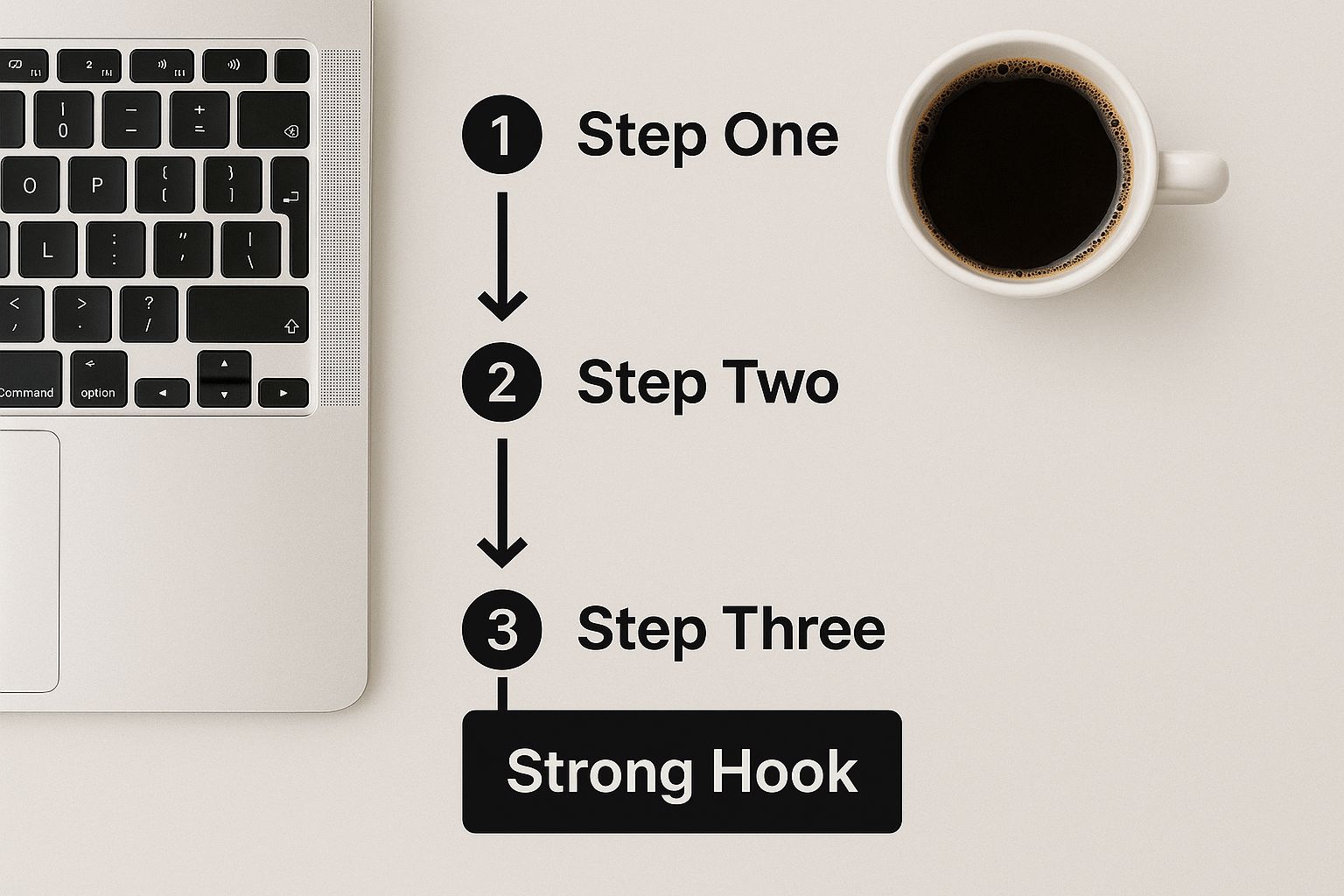
The real takeaway is that a powerful first sentence can grab a reader's attention immediately, making fancy formatting less of a necessity.
Pro Tip: I always tell students to write and perfect their essay in a word processor first. Then, copy and paste it into the submission box. This way, you have a master copy and can easily adjust for different portal quirks without losing your original work.
File naming is another small detail that makes a big difference. If they don't give you a specific format, go with a professional standard. It’s always a safe and impressive bet.
- File Naming: A clean, simple format like
LastName_FirstName_ScholarshipName_Essay.pdfworks perfectly. - File Type: This is a big one. Unless they explicitly ask for something else, always submit your essay as a PDF. A PDF locks in your formatting, ensuring the committee sees your document exactly as you intended. A Word doc can look completely different from one computer to the next, which could wreck the layout you spent so much time on.
Getting this right shows the committee you’re a candidate who values attention to detail—and that’s a trait every scholarship provider is looking for.
Handling Citations and External Sources with Confidence

Most scholarship essays are personal, pulling from your own experiences. But sometimes, a prompt will push you to back up your ideas with external facts or data. This is where knowing how to properly cite your sources becomes absolutely essential.
Let's be clear: getting this wrong can look like plagiarism, and that’s a fast track to the rejection pile, no matter how good your story is.
The trick is to weave your sources into your narrative so they feel like a natural part of your argument, not a clunky add-on. You're not writing a heavy-duty research paper; you're just adding a layer of credibility to your personal story.
Choosing the Right Citation Style
So, what format should you use? If the application instructions don’t give you a specific style guide to follow, you have a couple of solid, academically-sound options.
Generally, you can't go wrong with either MLA or APA. They are the two most common styles, and using either one correctly shows the committee you’re serious and detail-oriented.
- MLA (Modern Language Association): This is the go-to for humanities essays. It’s perfect if you're referencing literature, art, or authors.
- APA (American Psychological Association): Typically used in social sciences and STEM fields, this style puts a little more emphasis on the publication date of the source.
For a scholarship essay, a simple in-text citation is almost always enough. For instance, you could write: "As historian Jane Doe observed, the local program sparked a 40% increase in community engagement (Doe 112)." It’s clean, simple, and gets the job done.
The goal here isn't a massive, complicated bibliography. It's about showing your commitment to academic honesty. A clean, consistent citation proves you respect other people's work and know the basics of formal writing.
Weaving in Sources Without Sounding Like a Robot
The worst thing you can do is just drop a quote or a statistic into a paragraph without any context. It's jarring for the reader.
Instead, think of it as a three-step dance: introduce the idea, present your evidence (the quote or data), and then—most importantly—explain why it matters to your story.
Let’s say you’re writing about volunteering at a local food bank. You can add some serious punch to your experience by integrating a source. You might write something like: "Our weekend efforts were tackling a real and growing need. In fact, a recent city report revealed that food insecurity had jumped by 15% in our community last year (City Health Department, 2023)."
See how that little addition gives your personal experience a whole new level of authority and impact? You’ve just connected your actions to a documented, real-world problem.
Adding a Professional Polish to Your Final Draft
You’ve poured your heart and mind into the essay, and the core message is strong. Now it’s time for the final, crucial step: adding a professional polish that makes your work shine. These small refinements can be the deciding factor, showing the committee that you’re a serious, detail-oriented applicant.
Think beyond what a simple spell-check can catch. I'm talking about the subtle things that can make a document look sloppy, like inconsistent paragraph indentation or the old-school habit of putting two spaces after a period. A quick "find and replace" for double spaces is an easy fix that immediately makes your essay look cleaner and more modern.
Mastering the Final Details
Now, let's look at how the essay presents itself as a document. If the application portal doesn't ask for a separate title page, a simple, clean header is the professional way to include your information.
It doesn’t need to be complicated. A standard header should include:
- Your full name
- The name of the scholarship
- The date
Just place this in the top-left corner of the first page. This makes your essay instantly identifiable without creating any visual clutter that distracts from your opening sentences.
Paying attention to these finishing touches is not just about avoiding errors; it's about demonstrating respect for the reviewer's time. A polished, easy-to-read document makes their job easier and leaves a lasting positive impression.
This isn't just a hunch; the data backs it up. Market analysis shows that a significant 60% of students look for help with formatting, which tells you how much it matters. A 2024 survey even found that professionally formatted applications have a 20-25% better chance of getting past the first round of cuts. You can read more about how formatting impacts essay evaluations and see for yourself.
Finally, keep an eye out for awkward page breaks. Nothing looks more unprofessional than a single line of a paragraph left all by itself at the top or bottom of a page—what editors call a "widow" or "orphan." Nudge your spacing or margins just enough to keep your paragraphs whole. These little details add up to create a seamless, professional reading experience.
What If There Are No Formatting Rules?
It's a common scenario and, honestly, a bit stressful. You've poured your heart into the essay, and the application gives you absolutely zero instructions on how to format it. What do you do?
When in doubt, stick to the classic academic standard. It’s the safest and most professional choice.
Think clean, simple, and readable. That means a 12-point classic font like Times New Roman or Calibri, 1-inch margins all around, and double-spacing. This setup is the gold standard for a reason—it’s easy on the eyes and universally accepted.
Choosing a zany font or quirky layout might seem creative, but it often just distracts the reader. Your goal is for them to focus on your story, not your font choice.
The Dreaded Online Submission Box
We’ve all been there. You have a perfectly formatted essay in Microsoft Word or Google Docs, you paste it into a tiny text box on a website, and… poof. All your careful formatting vanishes.
The key is to anticipate this. Always draft your essay in a proper word processor first. When you're ready to submit, copy and paste it into the online form, but then look for a "preview" button. See what the reviewer will see.
If your paragraph breaks disappear, you may need to manually add an extra line break between paragraphs to create some white space. You'll also lose things like italics, so make sure your writing is strong enough to convey emphasis without relying on visual tricks.
To Title, or Not to Title?
This question comes up a lot. Should you give your essay a title?
Unless the application specifically asks for one, I generally advise against it. Your name and the rest of the application package already identify your work. A title can sometimes feel unnecessary or even a little cheesy if not done well.
If you’re absolutely set on using one, here are my ground rules:
- Keep it short and directly related to your essay's main idea.
- Center it at the top of the page.
- Don't make it bold, underlined, or italicized. Let it be simple.
Honestly, your first paragraph is your real title—it's the hook that pulls the reader in. If you're on the fence, just leave it out.
PDF vs. Word Doc: The Final Showdown
If the application gives you a choice between uploading a PDF or a Word file, the answer is simple: Always, always choose PDF.
Why? Because a PDF is like a digital snapshot. It locks in your formatting, ensuring that what you see on your screen is exactly what the scholarship committee sees on theirs. Word documents, on the other hand, can be fickle. They can look different on a Mac versus a PC or with different versions of the software, potentially messing up your margins, line spacing, or fonts.
Submitting a PDF is the single best way to protect all the hard work you put into making your essay look polished and professional.
At Izent Education, we know that getting these details right can make all the difference. We help students find their way to international programs, secure funding, and succeed academically. Ready to explore your future? Learn more at https://sologuru.com.ng.
Article created using Outrank