

So, what exactly is a "fully funded" PhD?
Let's get one thing straight: it’s not just a generous scholarship. Think of it more like an academic apprenticeship. The university is essentially investing in you as a junior researcher, covering your tuition and paying you a salary to live on.
In exchange for this support, you're not just a student—you're an active contributor to the university's research and teaching mission.
What Is a Fully Funded PhD Program?
Imagine earning the highest degree in your field without the crushing weight of student loans. That's the reality of a fully funded PhD program. Instead of you paying the university, the university pays you.
This whole model is built on a straightforward trade. The university provides the financial backing, and you bring your intellectual horsepower and dedication to the table, helping with research, teaching, or both. It’s less like being a student and more like having your first real job in academia.
The Anatomy of a Funding Package
When a university says a program is "fully funded," they're talking about a bundle of financial support, not just a single lump sum. Breaking down what's in that package is key to comparing offers and knowing what you’re really getting.
Most funding offers have a few core parts that create a financial safety net for your doctoral studies.
Here's a closer look at what a typical funding package includes:
| Funding Component | What It Covers | Typical Value/Arrangement |
|---|---|---|
| Tuition & Fee Waiver | The full cost of tuition and most mandatory university fees. | Often $40,000 – $60,000+ per year, depending on the institution. |
| Living Stipend | Your salary for housing, food, books, and other living costs. | Ranges from $25,000 to $45,000 annually, paid out bi-weekly or monthly. |
| Health Insurance | Full or heavily subsidized health coverage. | An essential benefit that saves you thousands in out-of-pocket costs. |
Knowing what to look for in these packages helps you see the true value of an offer beyond just the stipend amount. A slightly lower stipend might be a great deal if it comes with zero-cost health insurance and covers all student fees.
One of the biggest myths is that "fully funded" means you get a free ride with no strings attached. The reality is that your education is paid for in exchange for your work—usually as a teaching assistant for undergraduate classes or a research assistant in a professor's lab.
This is exactly why these programs are so competitive. They offer an incredible opportunity. For example, top-tier schools like Columbia University offer guaranteed multi-year funding across nearly all their PhD programs, from the humanities to hard sciences.
This structure allows students to dive headfirst into their research without the distraction of financial stress. By removing that barrier, universities can attract the best and brightest minds from all over the world. You can see more real-world examples by checking out this list of statistics PhD programs with full funding on Profellow.com.
The True Value of Securing Full Funding

Landing a spot in a fully funded PhD program is about so much more than just dodging a mountain of student debt. Think of it as the very first, and arguably most important, validation of your potential. It’s the university telling you, loud and clear, "We believe you have what it takes to produce important new research."
That vote of confidence is a huge motivator, but the real game-changer is the intellectual freedom that comes with financial stability. When you aren't scrambling to pay rent or juggling part-time jobs, you can pour all that mental energy directly into your research. This is the freedom you need to tackle the big, ambitious questions that demand absolute focus.
Building Your Career from Day One
The assistantships that almost always come with full funding aren't just a way to get paid. Whether you're a teaching assistant (TA) or a research assistant (RA), these roles are your first step into a professional career.
From the moment you arrive, you’re integrated directly into the department's daily life. You're not just another student sitting in a lecture hall; you’re a colleague, a mentee, and a contributing member of the team.
- Real Mentorship: You’ll work side-by-side with faculty members on their research or help teach their courses. These are the kinds of close professional bonds that can guide you for your entire career.
- Essential Skill Building: You get hands-on experience in teaching, running a lab, managing projects, and collaborating with a team. These are the exact skills you'll need for any high-level job, whether in academia or industry.
- Natural Networking: You quickly become a familiar face in the department. This leads directly to chances to co-author papers, get invited to present at conferences, and join in on exciting new projects.
Securing full funding turns your PhD from a simple academic pursuit into a true professional apprenticeship. It gives you the skills, the confidence, and the network to hit the ground running after graduation.
This model has become the global standard for bringing in top-tier talent. While the specifics of grants and stipends vary, the core idea is the same everywhere: universities use full funding to attract and support the best candidates. You can see how different schools handle this by looking at this overview of statistics PhD programs.
In the end, the value isn't just about what you don't have (debt). It's about what you do have: the space to think, the resources to innovate, and the connections you need to build a successful career.
Understanding Your Funding Options

When you hear “fully funded,” it’s easy to imagine a single, neat financial package. The reality is a bit more complex. The money that covers your tuition and provides a living stipend usually comes from different pots, and each one comes with its own set of responsibilities.
Figuring out these funding types is crucial because the work you do for your paycheck will directly shape your entire PhD experience. Most funding is tied to a specific role you'll play in the university, and the two most common paths are assistantships and fellowships.
The Assistantship Model
The vast majority of funding offers come in the form of an assistantship. Think of it as a part-time job that pays for your degree. This setup is designed to weave you into the academic life of your department right from the start, giving you hands-on experience that complements your own research.
You'll typically encounter two main types of assistantships:
- Teaching Assistantships (TAs): As a TA, you become part of the undergraduate teaching mission. This could mean leading your own discussion sections, grading papers and exams, or holding office hours to help students. If you have any interest in an academic career, this is invaluable. It’s a direct line to building your teaching skills and understanding how a university classroom really works.
- Research Assistantships (RAs): In an RA role, you're working side-by-side with a professor on their grant-funded research. One day you might be running experiments in a lab, the next you could be analyzing massive datasets or digging through historical archives. This path throws you into the deep end of your field, making you an active contributor to new discoveries from day one.
Your funding source isn't just a paycheck; it's a core part of your professional development. A TA position builds your teaching resume, while an RA role makes you a co-creator of new knowledge in your field.
The Fellowship Advantage
Fellowships are the other major funding route, and they operate a little differently. These are prestigious awards—basically grants—given to you to support your own independent work. Unlike assistantships, fellowships typically don't have a direct work requirement like teaching a class or contributing to a specific professor's project.
The biggest benefit here is freedom. Without those weekly duties, you have more time and mental space to dive deep into your own dissertation research, travel to archives or conferences, and focus entirely on making progress.
Fellowships can be internal (offered by the university itself to attract top candidates) or external (awarded by major organizations like the National Science Foundation). Winning one is a huge mark of distinction on your CV and can open up incredible opportunities down the line.
Knowing this funding landscape helps you position your application strategically. If you have a passion for teaching, you can highlight that to appeal to programs that rely heavily on TAs. If you have strong lab skills, you can showcase them to departments looking for talented RAs. This insight helps you find fully funded PhD programs that don't just pay the bills, but actually align with your personal and professional goals.
How to Find Fully Funded PhD Programs
Finding a great fully funded PhD program isn't as simple as a quick Google search. You have to be strategic and know where to look, because the best opportunities are often buried in departmental websites, niche academic job boards, and specialized research databases.
Think of university department websites as your ground zero. Head straight for the "Graduate" or "Prospective Students" sections and hunt for pages like "Funding," "Financial Aid," or "Admissions." This is where the gold is. You're looking for clear, detailed information on guaranteed funding packages, teaching or research assistantships, and any fellowships the department offers directly. If the language is vague, that's a red flag. The best programs are transparent and will tell you exactly what their standard funding offer covers and for how long.
Broadening Your Search Horizons
While going straight to the source is crucial, you also need to cast a much wider net to see what’s really out there. The search process itself can look pretty different depending on where in the world you're looking.
For instance, in the US, funding is almost always tied directly to the department you're applying to. But in many European countries, PhD positions are advertised more like actual jobs, complete with a salary.
To make sure you don't miss anything, add these key resources to your search toolkit:
- Academic Job Boards: Sites like FindAPhD.com, AcademicPositions.com, and UniversityJobs.com are fantastic, especially for European programs where PhDs are often listed as fixed-term research contracts.
- Specialized Databases: Don't forget about the professional organizations in your field. Groups like the American Historical Association or the Modern Language Association often have their own job boards listing funded positions that you won't find anywhere else.
- Networking: This one is huge. Talk to your professors and any current grad students you know. They often have inside information about which programs have a solid track record for funding or know about new research projects that will need PhD students soon.
This image gives a sense of where some of the largest clusters of funded PhD programs are located globally.
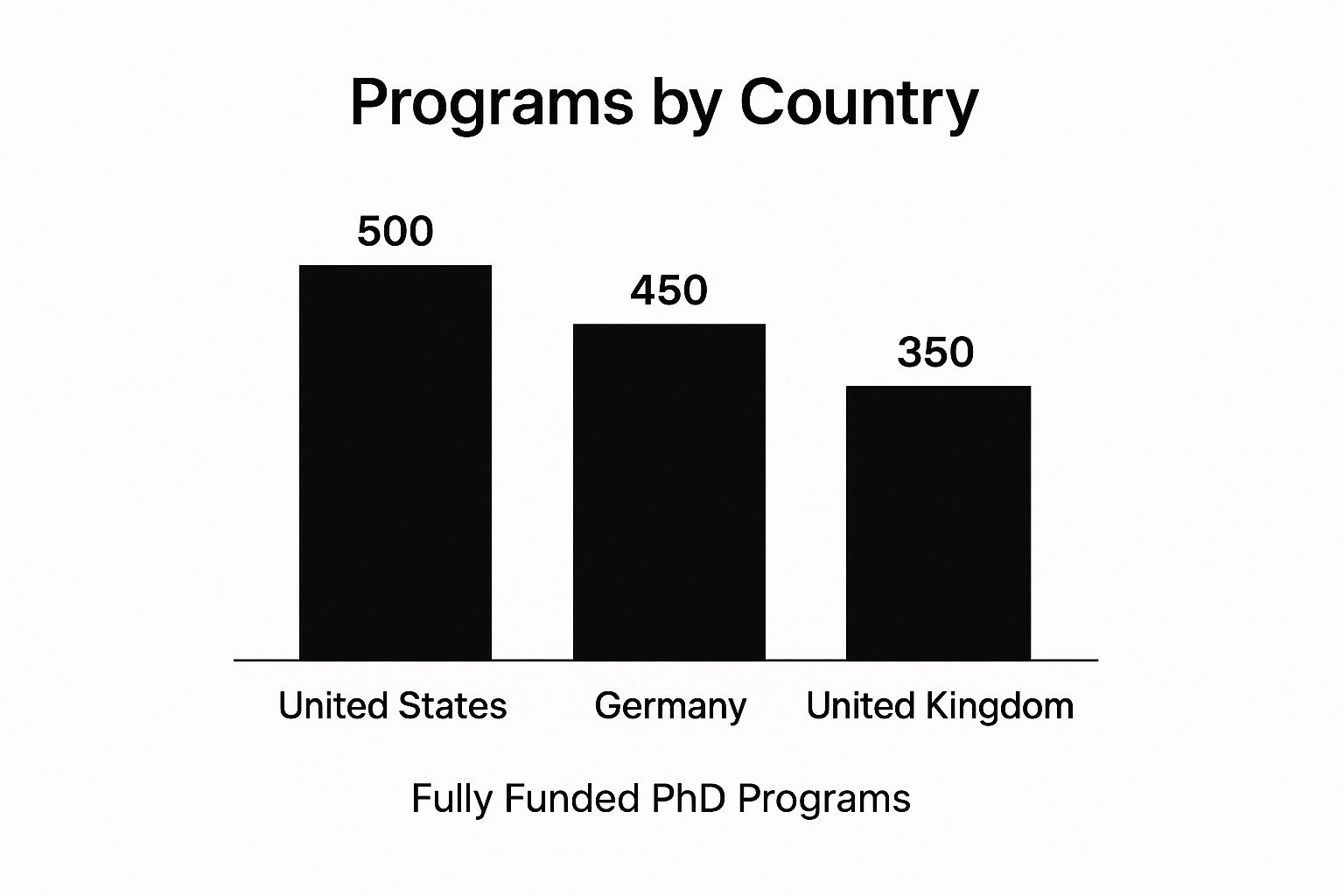
The data really drives home that while the US has a massive number of programs, countries like Germany and the UK are powerhouses for funded research and are definitely worth a serious look.
Exploring International Funding Models
It's really important to understand that the way a PhD is funded can vary dramatically from one country to another. The structure in the US is quite different from what you'll find across Europe.
Here's a quick breakdown to help you navigate the two most common systems.
US vs. European PhD Funding Models
| Feature | United States Model | European Model |
|---|---|---|
| Primary Structure | Student-centric. You apply to a program, and funding is a form of financial aid. | Employee-centric. You apply for a specific, salaried research position. |
| Funding Source | Typically from the university via teaching/research assistantships and fellowships. | Often funded by external research grants (e.g., EU grants) or national research councils. |
| Application Process | Apply to the graduate school or department. Funding is part of the admission offer. | Apply to a specific, advertised job opening, often with a Principal Investigator (PI). |
| Duration | Funding is usually guaranteed for 4-6 years, covering coursework and dissertation. | Funding is tied to the project, typically a fixed term of 3-4 years. |
As you can see, they're fundamentally different approaches. Neither is inherently better, but knowing the difference is key to a successful search.
In the UK, for example, many PhDs are funded through Doctoral Training Partnerships (DTPs). These are basically consortiums of universities that get big blocks of funding from research councils. You apply to the DTP for a "studentship," not just to a single university.
Meanwhile, other European institutions are moving toward structured doctoral schools. A great example is the IMT School for Advanced Studies Lucca in Italy, which offers 14 fully funded PhD positions each year across several fields. Their funding covers tuition and a living stipend for four years. This multidisciplinary model is popping up more and more across the continent. You can get a feel for how these are structured by checking out their specific economics and analytics PhD opportunities.
Key Takeaway: Landing a fully funded spot isn't about getting lucky. It comes down to a methodical, multi-pronged search. You have to dig into department websites, scour the right job boards, and understand the different funding systems at play globally. Do that, and you'll dramatically boost your chances of finding a program that not only fits your research goals but also gives you the financial stability you need to thrive.
Crafting a Standout PhD Application
Getting into a top-tier, fully funded PhD program is less about checking boxes and more about telling a compelling story. The admissions committee isn't just looking for good grades; they're searching for future colleagues. Your job is to build an application that convinces them you are an essential, can't-miss addition to their department.
At the heart of your application is the Statement of Purpose (SoP). This is your narrative. It’s where you connect the dots between your past experiences and your vision for the future. Think of it as your research manifesto: what questions keep you up at night? How have you already started trying to answer them? And, crucially, why is this specific program the only place you can see yourself doing this work? A great SoP shows you've done your homework and have a genuine understanding of the faculty's research.
Building Your Support System
While your SoP is your voice, your letters of recommendation are the powerful endorsements that back it up. These letters provide the outside proof of your skills, your drive, and your potential as a scholar. Getting strong letters isn't about just asking; it's the result of cultivating real relationships with your professors.
Here’s how to get letters that truly make an impact:
- Pick the Right People: Go for professors who know you well. A detailed, enthusiastic letter from a professor whose class you shined in is worth far more than a lukewarm one from a big-name academic who barely remembers you.
- Set Them Up for Success: Don't make them guess. Give your recommenders a "brag packet" with your SoP draft, your CV, transcripts, and a quick summary of your research goals. Gently remind them of a specific project you worked on or a conversation that highlighted your passion for the subject.
- Give Them Plenty of Time: This is a big one. Ask for a letter at least a month before the deadline. It's a professional courtesy that gives them the space to write something thoughtful and persuasive.
Your application package should tell one cohesive story. Your Statement of Purpose makes a promise about who you are as a researcher, and your letters of recommendation are the evidence that proves it.
Making Contact Before You Apply
Here's a pro-tip that many applicants overlook: reach out to potential supervisors before you hit submit. A short, professional email can do wonders. Introduce yourself, explain how your research interests align with theirs, attach your CV, and politely ask if they are planning to take on new students.
This simple step is incredibly strategic. First, you find out if the professor you're excited about is even available. There's nothing worse than writing a perfect application for a mentor who is on sabbatical or not accepting students.
Second, it starts a conversation. It puts a name to the application and shows you're a serious candidate who takes initiative. In the hyper-competitive world of fully funded PhD programs, that first impression can be the thing that sets you apart from a sea of other qualified applicants.
Frequently Asked Questions

Stepping into the world of doctoral applications can feel like navigating a maze. It's completely normal to have a ton of questions as you figure out how fully funded PhD programs actually work.
Let’s clear up some of the most common points of confusion. Think of this as your personal FAQ, designed to give you the clarity and confidence to take the next step.
Are Fully Funded PhD Programs Only for STEM Fields?
This is probably one of the biggest myths out there, but the answer is a firm no. While it's true that funding in science, technology, engineering, and math (STEM) is plentiful—thanks to massive research grants—the humanities and social sciences are far from left out.
The funding just looks a bit different. Instead of coming from a lab's research grant, it often comes directly from the university's budget. This usually takes the form of fellowships or, very commonly, teaching assistantships where you might lead a discussion section for an undergraduate history course. Top-tier universities know that great research and scholarship happen in every department, and they fund their students accordingly.
Do I Have to Repay a PhD Stipend?
Absolutely not. It’s crucial to understand that a stipend is a paycheck, not a loan. This isn't like the student loans you might have taken out for your bachelor's degree.
You receive that stipend as payment for the work you do for the university. Whether you're teaching, grading papers, or assisting a professor with their research project, you're earning that money. It's your income to cover rent, groceries, and other living expenses while you pursue your degree.
A PhD stipend is earned income, not borrowed money. The university pays you for your contributions to its teaching and research missions, allowing you to focus on your studies without accumulating debt for your living costs.
Can International Students Get Full Funding?
Yes, absolutely. Most top-tier universities offer their standard funding packages to all admitted doctoral students, no matter where they come from. These programs are in a global competition for the best and brightest minds, and they know that international students bring incredible value and diverse perspectives.
For that reason, teaching and research assistantships are typically open to everyone. The one thing to watch out for is external fellowships, especially those funded by national governments, as some may have citizenship requirements. Just be sure to read the fine print for any outside awards you apply for.
What Is a Competitive Stipend Amount?
What’s considered a "good" stipend really comes down to context. It depends on your field, the university, and, most importantly, the local cost of living. In the United States, you can expect annual stipends to range from roughly $25,000 to over $45,000.
But don't let the raw number fool you. A $30,000 stipend in a quiet college town could leave you with more disposable income than a $40,000 stipend in a major city like New York or San Francisco where rent is sky-high.
When you get an offer, do your homework. Look up average rent prices in the area. It’s also a smart move to ask the department if summer funding is guaranteed—a nine-month stipend is a very different financial reality than a twelve-month one. Getting the full picture is the only way to know the true value of any fully funded PhD program offer.
At Izent Education, our expertise lies in helping students like you find and land these incredible opportunities all over the world. We provide the guidance and resources you need for every part of the journey. To explore international programs and start planning your future, find out more at https://sologuru.com.ng.